


Why async python pipelines are vital for python updates and threat log ingestion
For teams managing high volume threat telemetry, building async python pipelines is a practical way to ingest, parse, batch, and forward logs without blocking CPU bound services. This article, in the python updates category, focuses on patterns you can use immediately to handle spikes in telemetry and maintain low latency forwarding to SIEMs or Kafka.

The guidance below covers design principles, libraries such as asyncio, aiokafka, and uvloop, concrete code examples, batching and backpressure techniques, and performance tuning. Expect actionable details for production deployments, not just theoretical discussion.
Design principles for high volume ingestion
Start with separation of concerns: ingest, parse, enrich, batch, and forward should be independent stages that can scale horizontally. Each stage should expose a bounded queue or async stream so backpressure propagates upstream and prevents uncontrolled memory growth.
Prioritize resilience and observability: graceful retries, dead letter handling, and metrics for queue depth, latency, and error rates are essential. Keep the pipeline stateless where possible so containers can be scaled or restarted without complex recovery logic.
- Bounded buffers and backpressure: avoid unbounded in memory queues
- Idempotent forwarding: allow safe retries without double processing
- Metrics and tracing: capture per stage latency and drop counts
Core libraries and stack choices
Choose libraries that match the throughput needs. asyncio provides the concurrency model, uvloop gives a significant event loop performance boost, aiokafka is a solid async Kafka client, and HTTPX or aiohttp handle upstream or SIEM APIs. Use multiprocess workers for CPU heavy parsing if needed.
Keep dependencies lean and test the end to end path. For binary data or transformations that must be fast, consider using compiled libraries or offloading to worker processes rather than blocking the event loop.
- asyncio for core concurrency
- uvloop to reduce event loop overhead
- aiokafka for Kafka producers and consumers
- aiohttp or HTTPX for SIEM HTTP ingestion
Async IO patterns and a minimal code sample
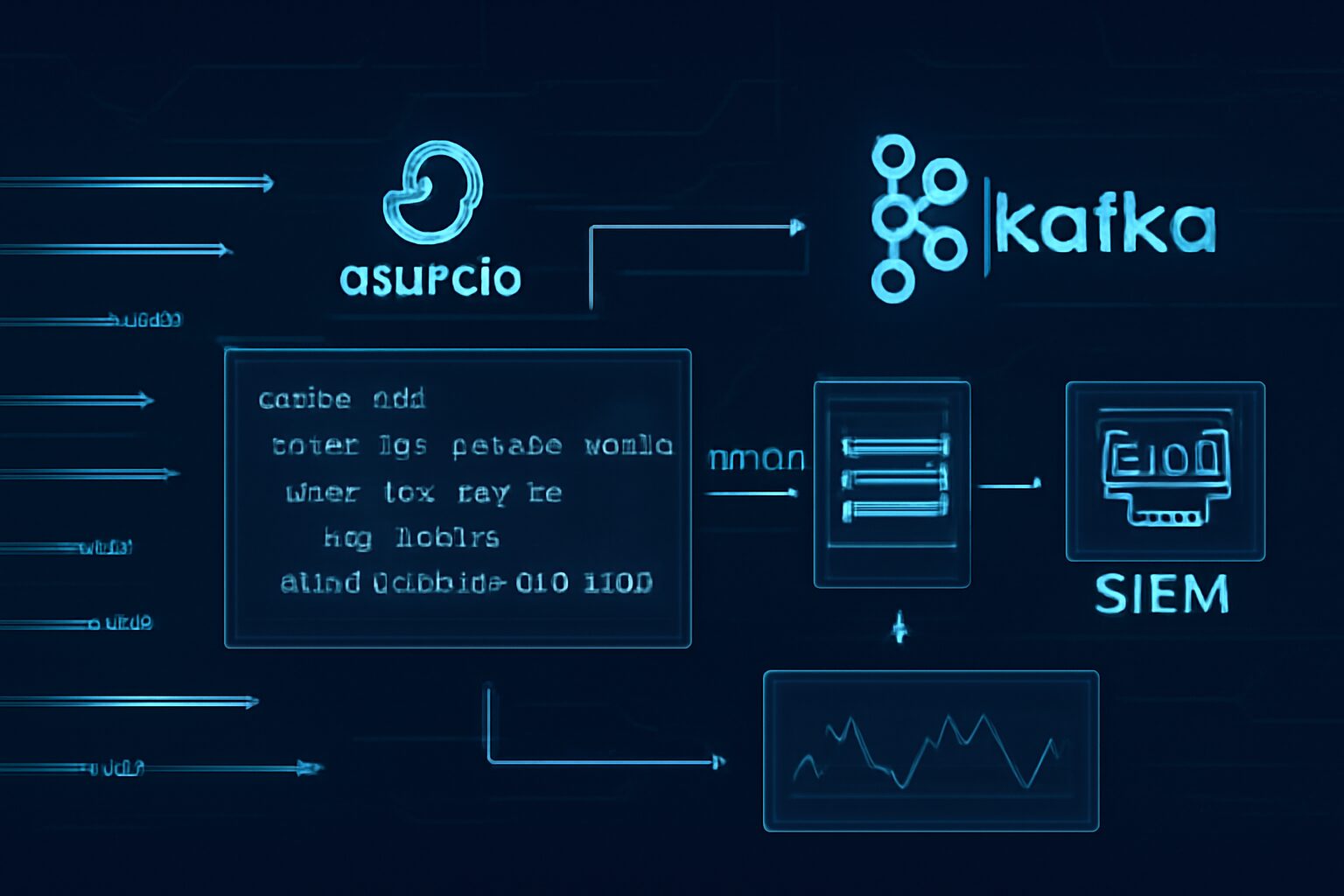
Use producer consumer coroutines with asyncio.Queue to decouple stages. A simple pattern is an ingest coroutine that reads sockets or files, a parse coroutine that normalizes records, a batcher coroutine that groups messages, and a forwarder that sends batches to Kafka or SIEM. Each coroutine awaits on a bounded queue to allow backpressure naturally.
Example minimal pipeline snippet using asyncio and aiokafka:
import asyncio
from aiokafka import AIOKafkaProducer

async def ingest(q):
    while True:
        msg = await read_log_line()  # placeholder
        await q.put(msg)

async def batcher(in_q, out_q, batch_size=500, timeout=1.0):
    while True:
        batch = []
        try:
            first = await asyncio.wait_for(in_q.get(), timeout)
            batch.append(first)
        except asyncio.TimeoutError:
            pass
        while len(batch) < batch_size:
            try:
                item = in_q.get_nowait()
            except asyncio.QueueEmpty:
                break
            batch.append(item)
        if batch:
            await out_q.put(batch)

async def forwarder(out_q, kafka_bootstrap):
    producer = AIOKafkaProducer(bootstrap_servers=kafka_bootstrap)
    await producer.start()
    try:
        while True:
            batch = await out_q.get()
            await producer.send_and_wait('threat.logs', b'|'.join(batch))
    finally:
        await producer.stop()
Batching and backpressure strategies
Batching improves throughput at the cost of some latency. Configure batch size and max wait time to balance the two. Use time based flush and size based flush together, so small bursts are sent quickly while steady high volume benefits from large batches.
Backpressure is implemented by bounding queues and allowing producers to block when downstream cannot keep up. For distributed setups, use Kafka as a buffer and tune retention and partitioning to match consumer parallelism.
- Size flush: send when batch reaches N records
- Time flush: send if oldest record waits longer than T seconds
- Queue bounds: set max size for asyncio.Queue to limit memory
Forwarding to Kafka and SIEM
For Kafka use aiokafka with send_and_wait to get delivery semantics. Use partition keys that improve distribution but avoid excessive sharding which can reduce batching efficiency. Monitor Kafka producer metrics such as record send rate and retry count.
For SIEMs that accept HTTP, use connection pooling and async clients. Bulk endpoints often exist, prefer those and match the batch shape expected by the SIEM. When HTTP is used, incorporate exponential backoff and circuit breaker patterns to avoid cascading failures.
Performance tuning, uvloop, and benchmarks
Switch the default asyncio loop to uvloop for improved performance with a single line import on startup. Measure using representative data and multi core setups. Typical gains from uvloop vary by workload but are often noticeable on high connection counts.
Benchmark common scenarios: small messages, large messages, and mixed. Capture throughput, end to end latency, and memory usage. Use the results to adjust batch size, queue bounds, and number of worker processes.
Error handling, retries, and dead letter flows
Implement per stage retries with capped exponential backoff. For messages that cannot be parsed or forwarded after retries, route them to a dead letter topic in Kafka or to persistent storage for later analysis. Keep failure handling idempotent where possible.
Log failures with context and include enough metadata to replay the message. Avoid swallowing exceptions silently, and expose failure counters to your monitoring system so you can detect systemic issues quickly.
Observability, metrics, and common FAQs
Collect metrics for queue sizes, batch sizes, processing latency, and downstream error rates. Export metrics to Prometheus and create dashboards for queue depth and delivery success. Tracing helps connect ingestion to final delivery to diagnose bottlenecks.
Below are common operational questions with concise answers for quick reference.
- How do I avoid losing messages on restart? Use Kafka as a durable buffer, commit offsets after successful forwarding, and persist small batches to local disk only when necessary.
- When should I use multiple processes? If parsing is CPU bound, run multiple worker processes and use a message broker or shared Kafka topic to distribute work.
- How do I measure the right batch size? Benchmark payloads with realistic traffic patterns, then pick a size that maximizes throughput without exceeding downstream limits or inflating latency.
- What is a safe retry policy? Start with a few short retries, then exponential backoff with a cap, and finally send to a dead letter flow if failures persist.
Deployment, scaling, and maintenance
Containerize the pipeline and treat it as a stateless service except for local buffering. Use Kubernetes or similar to scale replicas based on CPU and custom metrics such as queue depth. Use liveness and readiness checks tied to the ability to connect to downstream systems.
Maintain schema compatibility, monitor for slow consumers, and automate rollout with canaries. Keep runbooks for common incidents such as Kafka broker unavailability and SIEM rate limiting.
Conclusion
Building async python pipelines for high volume threat logs is highly practical for security operations and telemetry engineering. The combination of asyncio for concurrency, uvloop for event loop performance, aiokafka for durable buffering, and careful batching and backpressure design creates a resilient path from ingestion to SIEM or Kafka. Focus first on bounded queues and simple batching, then iterate with performance tests to tune batch sizes and worker counts.
Operational concerns matter as much as raw throughput: retries, dead letter handling, and observability prevent small issues from becoming outages. Deploy as stateless services with automated scaling and leverage Kafka as a persistent buffer when possible. With these patterns you can handle spikes in threat telemetry, maintain low latency forwarding, and keep the system observable and maintainable over time, enabling security teams to process more data reliably without sacrificing stability.